AutoGPT & Me
Explaining my history with the AutoGPT project.
In April of 2023 I got the chance to be part of agentic AI history. I was 18 years old and screensharing my code to forty strangers when the founder joined the call. The repo was three weeks old and had more stars than PyTorch.
Context
By 2022 I was in my freshman year of college. I had already been programming for a few years with C#, Python, and a little bit of Javascript. So when ChatGPT came out I was already interested in using it programmatically. I had messed around with AI powered discord bots, categorization flows with GPT-3.5 and GPT-4 and generally poked around with them throughout early 2023.
So when I was scrolling YouTube one day in April 2023 and saw a small youtuber covering a new project called “AutoGPT” I was immediately hooked. The concept was elegant if a little simple in retrospect. Using LLMs to write JSON data + a parser that would take JSON and use it as inputs for a command, in a loop. Replacing manual user messages with programmatic results from whatever JSON the LLM generated.
I joined the AutoGPT discord in the same night that it was blowing up. I was in the server sharing my screen as I worked on a feature PR that would add Selenium (A browser library) based visualization of the LLM searching the internet. If I recall correctly there were maybe 30-40 people in the Voice chat watching my stream, eventually including the creator of AutoGPT Toran Bruce Richards AKA Significant Gravitas.
Joining AutoGPT
A lot of discussions happened that night around organizing contributions in places like Notion and eventually a whole separate discord server was created for an internal group of contributors to assist with the development of the project. I was very lucky to end up in this inner circle of developers who got to have a close say on the project. Being in that group is actually how I eventually got a video I recorded at 18 years old published on the official README.md of the project. I was credited directly for the video which mostly covered the web browsing feature. A handful of forks from around that time still show that video in their README.md
For about a month or so the internal group of contributors would have multiple stand ups a week to discuss what was being worked on. There was maybe 8-10 individuals who attended including Toran. I’m still very appreciative of the experience it taught me in working in a pseudo-professional environment. I had the ability to provide feedback to things like the logo that was being developed at the time, as well as actual project direction. It was like working part time at a startup for that month!
My primary contributions were more research and development focused at that time. The team had individuals with industry experience in Web design, front-end, back-end, branding, etc. So as a 18 year old kid in my second semester of college, I was focused on both learning from them when I had the opportunity, as well as exploring the space. I was brainstorming new and unique solutions to some of the problems being faced early in the development of what would later become agentic harnesses for AI.
Internal R&D Engineering
The Tool Loop
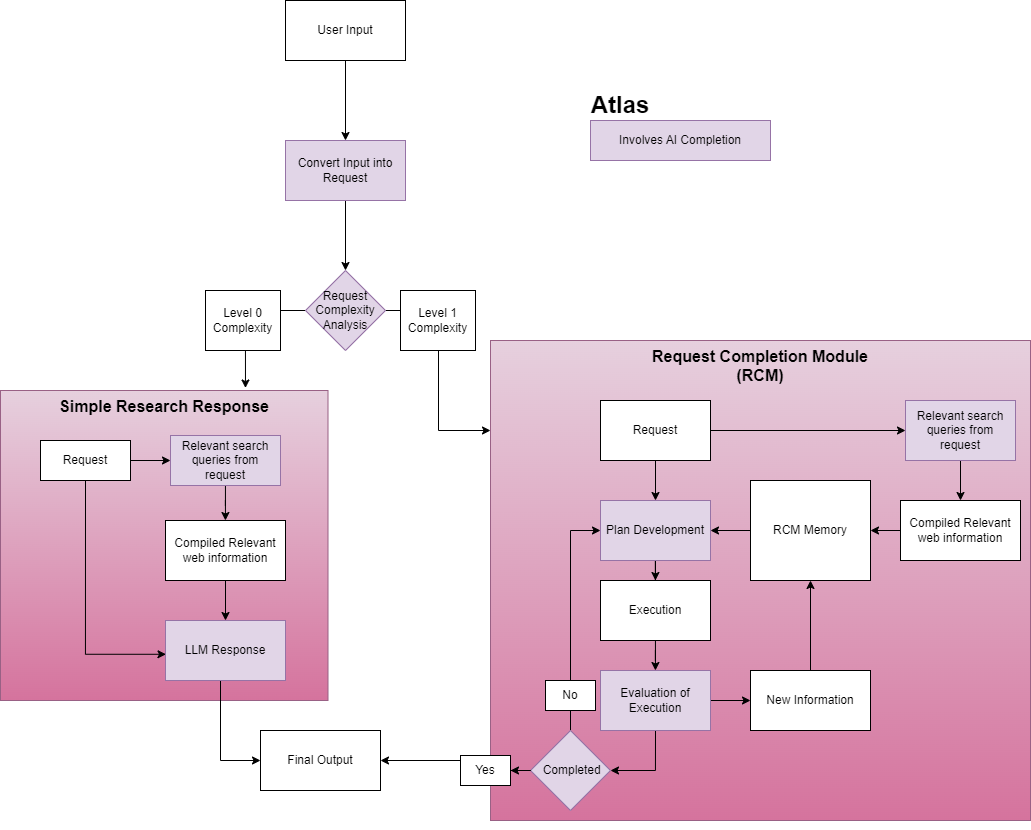
Before things like ChatGPT’s Assistants API canonized the shape of an agentic loop, I had a few AI workflow concepts that I would turn into flow charts to show the AutoGPT team. Above is probably the most complex one I ever made, and I think it’s a good example of the kind of idea work I was doing in that time.
To explain the graph to the best of my memory: At the time, AutoGPT was not capable of answering questions without a tool. AutoGPT as a program only had the ability to run in a loop until it output a specific tool that marked it as finished with a task. So the idea was to segregate different types of tasks into “Simple” (Asking a question) or “Complex” (Asking for a long running set of tasks)
The routing between the 2 modes was designed to just be a cheap call of “Is this a simple question or a complex task” + the context of the actual user input.
For the simple side the idea would be that the question would be passed to an LLM to generate a set of google search queries, and that you would then pass the web results + the question to an LLM for a final result.
For the complex side, it was closer to what the existing shape of AutoGPT was at the time. A request would be passed in. A plan would be generated, and the LLM would flow through the steps it defined for itself, and would adjust it’s plan if anything didn’t go as planned, eventually outputting a tool to announce completion once the plan was done. I think a lot of the design here was a bit ahead of its time because the workflow here didn’t directly solve the issues that the project was having at the time like GPT-4 consistently repeating the same tool on repeat.
I do also want to clarify that I actually do not remember what the acronym “RCM Memory” is referring to. This graph was made in April of 2023. There is a “Reactive Composite Memory” published in October of 2025, and while I wish I could tell you that I created Reactive Composite Memory in 2023, I believe the memory flow we were using was basic vector RAG that was just getting popular at the time, and that the acronym is purely a coincidence.
Recursive Chunking & Summarizing
When I joined the project, AutoGPT was specifically designed around GPT-4, which for those who weren’t in the space at the time, was a model that only had an 8k context window and would cost extra to have a 32k token window.
That token window was the bane of our existence at the time. I vividly remember cheering out in excitement watching the November 2023 OpenAI dev day and hearing Sam Altman announce that GPT-4 turbo would have a 128k token window. It’s very funny because now just under 3 years later Any model with under 200k tokens is seen as unusable by most people in the space. This token poverty was felt most in web search.
For context: the existing flow for web search in AutoGPT was simple. DuckDuckGo Search -> Return the top 8 results -> for each result, split it’s text into chunks of 8192 characters (Around 2,000 tokens so that GPT-3.5 could be the one to perform the Summarizing) -> Summarize each chunk to 300 tokens -> compile all the summarized chunks and then summarize them into a 300 token final output.
The only novel part of it was the optional addition of a question that would direct the agents on what to summarize. (After looking back through the git history, I give props to Prestoj for this feature)
The problem with this was that it would often lose important data due to asking to turn 8192 characters into 600, and it was done sequentially which for these slower models often meant that it would take nearly a minute to read a web page.
My idea of Recursive Chunking & Summarizing was a private experiment I had demoed to the AutoGPT team but never got integrated before the project pivoted. The experiment tried to solve both of these problems. My python system, alongside GPT-3.5 was able to extract information from arbitrarily long texts include entire books or TV show transcripts. (More than 100,000 tokens analyzed from a model that only supports 4096 tokens)
The flow was similar to AutoGPT’s system, but was less focused on an end result of tokens, and more focused on answering a question or pulling up a specific piece of information. It went as follows:
- Chunk all of the text into 8192 character chunks
- For each chunk, pass a question and the chunk to the LLM, with instructions to output a specific response if the chunk contained no relevant information for the question.
- Chunks that contained no relevant information were culled, while chunks that did contain relevant information were summarized to focus on just that information.
- The surviving, summarized chunks were merged into one new document
- The new document would be chunked into 8192 character chunks, repeating the same flow of culling, summarizing, etc, until the merged document itself was under 8192 characters.
The whole thing would run at max parallelism that I could get working which was about 16 simultaneous LLM calls for separate chunks.
The example I used at the time was the entire transcript of the TV Anime Neon Genesis Evangelion. I would ask GPT-3.5 “What is the first thing Asuka says to Misato” And since the transcript was from a specific fan translation, I was confident it wasn’t already in the training data. The system extracted directly from the transcript of over 100,000 tokens into an answer that could fit in the context window of GPT-3.5
AutoGPT Today
Sometime after November 2023 when I had to pivot my focus more towards school, AutoGPT transitioned away from the TUI project that I was familiar with, focusing more on developing a proper platform. Today https://agpt.co/ hosts a fully fledged web platform with a very nice SaaS setup. And while I don’t claim any credit for anything that happened after 2023, It’s been very nice to see where AutoGPT ended up as a high quality, open source platform that still encourages contribution!
I’ve gotten the chance to swing in a couple times and contribute to AutoGPT, and encourage anyone reading to contribute as well if you are interested in helping out some of the most unsung developers of the agentic AI age! I will always remember AutoGPT as the first place I got to experience real software engineering with a team, and I hope they continue to do well into the future!